Woven Wire Mesh
Overview
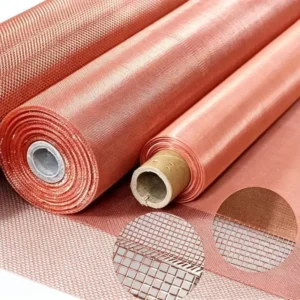
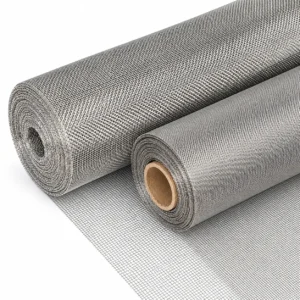
Woven wire mesh is manufactured by interweaving longitudinal and transverse wires rather than welding them together. This manufacturing method provides excellent flexibility, dimensional accuracy and stable mesh openings while maintaining good mechanical strength.
Different weaving patterns are available to meet various filtration, screening and protection requirements. Common weave types include plain weave, twill weave and Dutch weave. Depending on the application, woven wire mesh can be produced from stainless steel, galvanized steel, brass, copper and other metal materials.
We supply woven wire mesh in rolls or cut-to-size pieces with a wide range of mesh counts, wire diameters and roll widths. Products can be customized according to filtration accuracy, opening size, material grade and project requirements for industrial, architectural and processing applications.
Weave Type
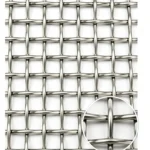
Plain Weave
Plain weave is the most common weaving method, where each warp wire passes alternately over and under each weft wire. It provides uniform mesh openings, stable construction and good strength. Plain weave is suitable for general filtration, screening, protection and architectural applications.
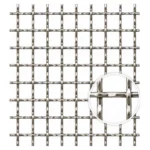
Crimped Weave
Crimped weave uses wires that are pre-crimped before weaving. It is commonly used for thicker wires and lower mesh counts, providing firm wire positioning, uniform openings, and a rigid structure suitable for screening and protective applications.
Twill Weave
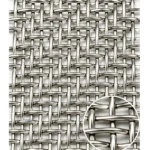
In twill weave, each wire passes over two and under two crossing wires, allowing the mesh to be woven with finer openings and thicker wire diameters. It offers higher wear resistance and is commonly used for fine filtration, heavy-duty screening and industrial processing.
Dutch Weave
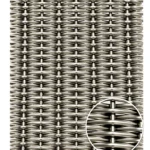
Dutch weave uses different wire diameters for warp and weft wires to produce extremely fine filtration openings. It provides excellent filtration accuracy while maintaining high mechanical strength, making it ideal for liquid filtration, gas filtration and pressure filter systems.
FAQ
Mesh count refers to the number of openings in one linear inch (25.4 mm) of woven wire mesh. For example, 20 mesh means there are 20 openings per inch, while 100 mesh means there are 100 openings per inch.
In general, a higher mesh count results in smaller openings and is suitable for finer filtration. A lower mesh count provides larger openings, allowing higher flow rates and better ventilation.
It is important to note that mesh count alone does not determine the opening size. Wire diameter also affects the actual opening. Two meshes with the same mesh count but different wire diameters may have different opening sizes.
Yes. Crimped wire mesh is a type of woven wire mesh. For heavy-gauge products, the wires are typically pre-crimped before weaving, allowing the warp and weft wires to lock securely at each intersection. This structure improves dimensional stability, load-bearing capacity and wear resistance. Crimped wire mesh is widely used for mining screens, quarry screening, vibrating screens, industrial separation and architectural applications.
When customizing woven wire mesh, the material, weave type, mesh count or opening size, wire diameter, product dimensions, and edge treatment usually need to be confirmed. Common materials include stainless steel, galvanized steel, copper, and brass, while available weave types include plain weave, twill weave, and Dutch weave. For filtration applications, the required filtration rating, operating temperature, corrosive environment, and working pressure should also be specified. Woven wire mesh can be supplied in rolls, cut sheets, discs, or other custom shapes, with additional services such as edging, welding, stamping, and further fabrication.